Analytics
- IDK
- Theory and Data should match
- Emotions should not come into play
- IDK
- Data
- Insights
- Recommendations
Aspects
- Financial Reporting
- Strategy
- Opportunity sizing
- Incremental revenue estimation
- Forecasting
- Product Analytics
- Customer Journey
- Customer Growth
IDK
- Define KPIs = key metrics
- If a KPI going up/down does not instigate any action, then it is useless
- Have a Northstar KPI
- Best growth KPI: Retained
MAUYOY - Best performance KPI: Total
GMV
- Best growth KPI: Retained
- Decompose KPI into drivers to form a metric tree
- For eg:
- Total
GMV- =
# OrdersxAOV # Orders- =
# CustomersxOrder Frequency
- =
- =
- Total
- For eg:
IDK
- Dimensions
- Country
- City
- Metrics/Measures/Facts
- Additive
- Orders
- GMV (EUR)
- Hits
- Non-additive
- Users
- Sessions
- Semi-Additive
- Cross-Sectional
- GMV (LC)
- Additive within same country, not across countries
- GMV (LC)
- Temporal
- Balance (EUR)
- Additive within same time point, not across time points
- Balance (EUR)
- Cross-Sectional
- Additive
Tracking
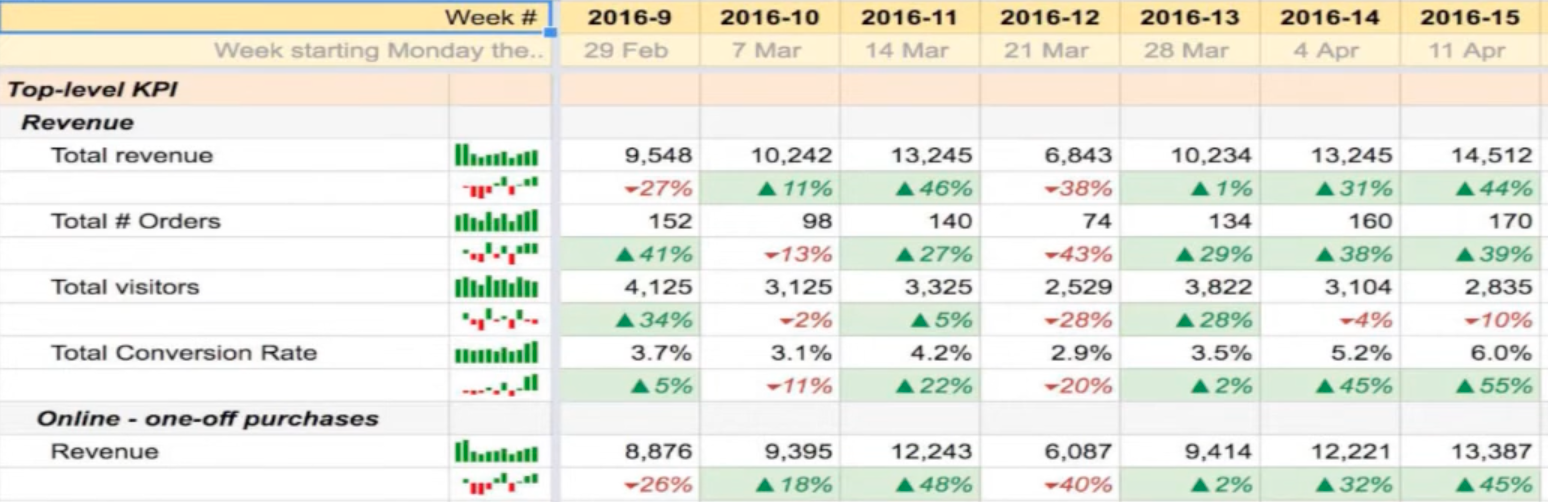
- Column:
- Time period
- Rows:
- Metric
- Compared to
- Change in metric
- % change in metric
- Impact of change in metric on change in north-star
- KPI decomposition
- Values
- Spark line/bar
- Value
- Color
- For every metric, the ranges must be defined
- Red = Horrible
- Orange = Poor
- No color = Neutral
- Light green = Good
- Green = Great
- For every metric, the ranges must be defined
- Comparison
- Comparison value
- Target for period
- Base period common for all
- PoP (Period-on-Period: Current period vs Previous period)
- Resolution
- YoY
- YTDoYTD
- MoM
- MTDoMTD
- WoW
- WTDoWTD
- DoD
- DTHoDTH
- HoH
- Comparison value
Metrics
- North star
- Top-Level
- Orders
- Users
- Conversion
- Financials
- Net Profit
- Gross Profit
- Revenue
- Performance
- GMV
- Basket Value
- Drivers/Levers
#Vendors- CARC %
- Discount %
- Product
Incrementality using Diff-in-Diff
Cohort - Order Month
Segments - Country, in \(T-1\) - Order frequency, in \(T-1\) - 0-1 - 2-3 - etc - Lifecycle, in \(T\)
- Overall incrementality is a weighted average
- The estimated incrementality is the ATT
| Lifecycle | Sub-Group | User Definition | ATT in T+h |
|---|---|---|---|
| Retention | Control | Not interacted with treatment until \(T+h\), but retention customer | 0 |
| Treatment attributed | Retention order via treatment | Diff-in-diff (Order frequency of cohort in \(T+h\)) - (Order frequency of cohort in \(T-1\)) - (Order frequency of Control in \(T+h\)) - (Order frequency of Control in \(T-1\)) | |
| Non-Treatment attributed | Retention order not via treatment, but interacted with treatment otherwise | Diff-in-diff (Order frequency of cohort in \(T+h\)) - (Order frequency of cohort in \(T-1\)) - (Order frequency of Control in \(T+h\)) - (Order frequency of Control in \(T-1\)) | |
| Winback | Control, \(T-p\) Use as many \(p\) lag cohorts as required, for eg: \((T-2), (T-3), (T-{4,6}), (T-{7,12}), (T-{13+})\) | Not interacted with treatment until \(T+h\), but winback customer | 0 |
| Treatment attributed, \(T-p\) Use as many \(p\) lag cohorts as required, for eg: \((T-2), (T-3), (T-{4,6}), (T-{7,12}), (T-{13+})\) | Winback order via treatment | Order frequency of cohort in \(T+h\) OR Diff-in-diff (Order frequency of cohort in \(T+h\)) - (Order frequency of cohort in \(T-p\)) - (Order frequency of Control in \(T+h\)) - (Order frequency of Control in \(T-p\)) | |
| Non-Treatment attributed, \(T-p\) Use as many \(p\) lag cohorts as required, for eg: \((T-2), (T-3), (T-{4,6}), (T-{7,12}), (T-{13+})\) | Winback order not via treatment, but interacted with treatment otherwise | Same increment as Retention - Non-Treatment attributedOR Diff-in-diff (Order frequency of cohort in \(T+h\)) - (Order frequency of cohort in \(T-p\)) - (Order frequency of Control in \(T+h\)) - (Order frequency of Control in \(T-p\)) | |
| Acquisition | Control | Not interacted with treatment until \(T+h\), but acquired customer | 0 |
| Treatment attributed | Acquisition order via treatment | Order frequency of cohort in \(T+h\) OR Diff-in-diff (Order frequency of cohort in \(T+h\)) - (0) - (Order frequency of Control in \(T+h\)) - (0) | |
| Non-Treatment attributed | Acquisition order not via treatment, but interacted with treatment otherwise | Diff-in-diff (Order frequency of cohort in \(T+h\)) - (0) - (Order frequency of Control in \(T+h\)) - (0) |
Output
| Cohort | \(T-3\) | \(T-2\) | \(T-1\) | \(T\) | \(T+1\) | \(T+2\) | \(T+3\) |
|---|---|---|---|---|---|---|---|
| 2025-01-01 | \(\approx 0\) | \(\approx 0\) | \(\approx 0\) | ||||
| 2025-02-01 | \(\approx 0\) | \(\approx 0\) | \(\approx 0\) | ||||
| 2025-02-01 | \(\approx 0\) | \(\approx 0\) | \(\approx 0\) |
A/B Testing
WITH
agg_users AS (
SELECT
    a.account_id,

    COUNT(a.order_id) AS order_count,
    SUM(a.gmv_amount_eur) AS gmv_amount_eur,
FROM orders a
GROUP BY ALL
),
agg_users_2 AS (
SELECT
    a.*,
    a.gmv_amount_eur/a.order_count AS aov_eur,
FROM agg_users a
),
agg_user_buckets AS (
SELECT
    a.*,
    N_TILE(10) OVER (ORDER BY order_count    DESC) AS order_count_bucket,
    N_TILE(5)  OVER (ORDER BY gmv_amount_eur DESC) AS gmv_amount_eur_bucket,
    N_TILE(5 )  OVER (ORDER BY aov_eur        DESC) AS aov_eur_bucket,
FROM agg_users_2
),
agg_user_buckets_2 AS (
SELECT
    a.*,
    CONCAT(order_count_bucket, '-', gmv_amount_eur_bucket, '-', aov_eur_bucket) AS bucket_id,
FROM agg_user_buckets
),
agg_hash AS (
SELECT
    a.*
    FARM_FINGERPRINT( CONCAT(a.bucket_id, 'seed_2026-04-21') ) AS bucket_hashed,
    FARM_FINGERPRINT( CONCAT(CAST(a.account_id AS STRING), 'seed_2026-04-21') ) AS account_id_hashed,
FROM agg_user_buckets_2 a
)
agg_rn AS (
SELECT
    a.*,

    ROW_NUMBER() OVER w AS rn_user,
    DENSE_RANK() OVER (ORDER BY bucket_hashed) AS rank_bucket, -- all users within the same bucket should get the same value for this
FROM agg_hash a
WINDOW
    w AS (PARTITION BY a.bucket_id ORDER BY a.account_id_hashed) -- Randomize within strata
)

SELECT
    a.*,
    CASE MOD(a.rn_user + DIV(a.rn_user, 2) + a.rank_bucket, 2)
        -- 2. keep alternating between Treatment, Control and Control, Treatment
        -- 3. last-one-out of each strata is assigned to treatment or control randomly
        WHEN 1 THEN 'Treatment'
        ELSE        'Control'
    END AS experiment_group,
FROM agg_rn
Dimension - Segment by logical covariates - For eg: Vendors live in base period and exp period, etc
Output Evaluation of difference - Cross-Sectional - Difference within time period, across groups - Temporal - Difference within group, across time - Cross-Temporal - Difference across groups and time
Performance
3 sections - High lights - Neutral - Low lights
Sub sections 1. What happened? Actual vs Target 2. So what? 3. Why/How it happened? 4. What are we doing now? 5. Action
- What should we do going forward?
- Expected inc impact of action
- Owner, timeline
Detailed - cohorts - segments
Funnel
Dimensions - Entry point - Second touch point - CVR first session, Cvr, cvr exc current session, ctr
- Overall funnel
- Search space filter
- aggregations: abs, change, drop/signed change, % change
- metrics: orders, views
- supply-side and demand-side
- cohorts
- segments - actionables - zone, city, brand, outlet
- Focused Funnel
Do the entire funnel for demand-side AND supply-side - Treat brands, outlets, areas like how we treat segment of users - CVR, CTR, etc
IDK
-
If your objective is to measure what a bad experience feels like with zero distortion from fast traffic, adopt Truncated Mean (also called Threshold-Filtered Average):
-
Define what "bad" means in your domain: e.g., anything taking longer than 1.5 seconds.
-
Compute:
Average(Latency where Latency >= 1.5s)
This metric answers your exact question: "When a user experiences a slow request, how slow is it on average?"—and adding 1,000,000 fast requests will leave it completely untouched.